
Rumpelstiltskin AI: Is the Meme AI, and How to Make One
Yes, the Rumpelstiltskin tiptoe meme is AI-generated, not a scene from the 1987 movie. Here is where it came from, plus steps and prompts to make your own.
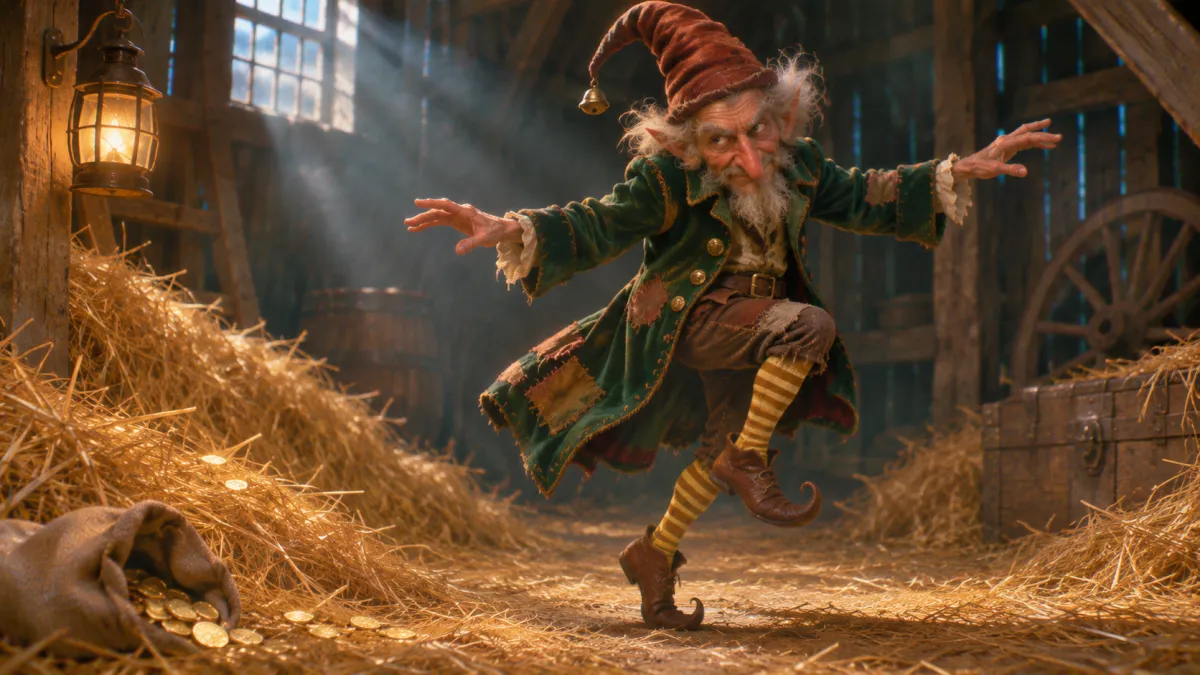
A small, creepy man in a barn tiptoes toward a crying woman, shushes her, and breaks into a dance while Riff Raff raps about his Jordans. You have seen it a dozen times, and you are fairly sure you saw it years ago too, on a VHS tape or late-night TV. So you search for the movie. Was it the 1987 Rumpelstiltskin? Some lost Russian fairy-tale film?
It was neither. The Rumpelstiltskin meme is AI-generated. There is no movie to find, which is why the search never ends anywhere.
This guide answers the "is it AI" question with sources you can open, explains why so many people remember a film that does not exist, and then shows how to make your own tiptoe dance video with your own photo or an original character. On what this is based: the origin facts come from Know Your Meme, NBC News and Yahoo News reporting, all linked at the end. The how-to section is based on a code and config review of Vogoo's tools as of 2026-11-11 rather than generation tests. Where we could not confirm something, we say so.
Is the Rumpelstiltskin meme AI?
Yes. Know Your Meme lists the meme as confirmed and classifies it as AI-generated. NBC News reported on October 7, 2026 that the original clip was posted in August by Tatyana Tereshchenko, who describes herself as an AI artist and filmmaker.
Here is the short version of what the sources agree on:
| Question | Answer | Source |
|---|---|---|
| Is the clip AI-generated? | Yes, confirmed | Know Your Meme, NBC News |
| Who posted the original? | Tatyana Tereshchenko (@stroinaya), with the Neuroferma and Anna Glinskaya pages listed as collaborators | Know Your Meme, Yahoo News |
| When? | August 27, 2026, on Instagram | Know Your Meme |
| Is it from the 1987 movie? | No | NBC News, Yahoo News |
| What is the song? | "Tip Toe Wing in My Jawwdinz" by Riff Raff, a 2014 single | Wikipedia (Neon Icon) |
| Which AI tool made the clip? | Not stated in the sources we read | — |
That last row matters. Several sites name a specific video model as the tool behind the clip. None of the reporting we could open confirms one, so we are not repeating a guess.
Where the clip actually came from
According to Know Your Meme, the video went up on Instagram on August 27, 2026. It was styled to look like a 1980s fantasy film. Yahoo News adds that the Russian-language caption promoted a course on making AI films without actors, a camera or a big budget. In other words, it was a demo reel.
The full scene is longer than the meme. A Rumpelstiltskin-like character walks into a straw-filled room where a woman is crying. He dances, the straw turns into gold coins, she kisses him, and he turns into a prince. As Know Your Meme points out, that is not even how the fairy tale goes.
The meme came a month later. On September 29, TikTok user @6aimbot9 posted the clip with the caption "The type of dreams I be having after taking dollar store melatonin". Within days people were pairing it with the Riff Raff track, and by early October it was everywhere on TikTok, X and Instagram Reels. On October 18, Jacksonville Jaguars players recreated the dance as a touchdown celebration in London, which pushed it into a second wave.
The song is real and much older than the clip. "Tip Toe Wing in My Jawwdinz" was released on June 10, 2014 as the second single from Riff Raff's album Neon Icon. "Jawwdinz" is his spelling of Jordans, which is where "tiptoeing in my Jordans" comes from.
Why everyone thought it was the 1987 Rumpelstiltskin movie
There really is a 1987 Rumpelstiltskin. It is a Cannon Films musical fantasy directed by David Irving, with Amy Irving as the miller's daughter and Billy Barty in the title role. So when a grainy clip of a short man dancing in a barn appeared, the 1987 film was the obvious suspect. NBC News notes that some viewers were convinced it came from that movie, and that it took days before people realized it was AI.
Three things made the mistake easy:
- The look was deliberate. The clip was generated in the style of a 1980s film: soft focus, film grain, stage-like lighting. That look hides the smooth, too-clean surface people use to spot AI.
- A real film sits in the same spot in your memory. You do not need to have seen the 1987 movie. Knowing that one exists is enough for the clip to feel like a half-remembered scene.
- It reached most people as a meme, not as a post. By the time it arrived on your feed it had a song and a caption, and no link back to the Instagram account that made it.
Yahoo News quotes commenters who swore they had "been seeing this guy for years". That is a shared false memory, the same effect that makes people remember a monocle on the Monopoly man.
How to check a clip like this yourself
You can run the same check on the next "lost movie" clip in under two minutes:
- Search the cast and the scene, not the vibe. A real film has a cast list. The 1987 film's lead is Billy Barty, and the character in the meme is not him.
- Look for the earliest post. Meme databases and reverse video search usually lead back to one account. Here it is an AI filmmaker's Instagram page.
- Read what the poster says they do. Tereshchenko presents herself as an AI artist. The answer was on the profile the whole time.
How to make your own tiptoe dance video with AI
Once people knew the clip was AI, it turned into a template. The popular edits swap the dancer for someone else. NBC News lists versions with TV characters, public figures and brand mascots.
Most guides stop at "upload a face". We suggest two changes. Use your own photo or an original character instead of a celebrity or the creator's character, and use your own reference clip instead of the original video. The original clip is someone's work, and a real person's face in a fake video is a consent problem. Your own goblin doing your own bad dancing is funnier anyway.
There are two ways to do it. Which one you need depends on how exact the dance has to be.
| Motion control | Image to video with a prompt | |
|---|---|---|
| Where the moves come from | A short clip you film | The model's guess from your text |
| Matches the tiptoe dance | Follows your reference clip (results may vary) | Loosely |
| What you need | One character image + a 3–30 second clip | One image + a prompt |
| Best for | The actual meme dance | An "80s fantasy film" scene with a little movement |
Method 1: copy the dance with motion control
A text prompt cannot describe choreography. It only lets the model guess. Motion control takes the moves from a video instead and puts them on your character.
- Make or choose the character. Use a full-body photo of yourself, or design an original character in the AI Character Maker, which works from a text prompt or a photo. Plain text to image works too. Keep the whole body in frame, feet included, because the joke is in the feet.
- Film the reference. Prop your phone up and film yourself doing the tiptoe dance for 8 to 12 seconds. One person, one continuous take, whole body visible, no zooms. Motion control copies the movement and not your face, so nobody will see this footage.
- Open Motion Control AI and upload both files. The character image must be PNG or JPEG, up to 5 MB and at least 340 px. The clip must be MP4 or MOV, up to 100 MB and 3 to 30 seconds long, with one performer in frame.
- Pick a preset. The tool supports Kling 2.6 and Kling 3.0 at both 720p and 1080p, defaulting to Kling 2.6 Motion Control (1080p). Credit costs are displayed on screen for each option. Testing your movement with a lower-resolution 720p preset first is a good way to check alignment, and you can switch to a 1080p preset once you see your own test results.
- Add a scene prompt if you want the barn. The prompt is optional. It steers the setting and the look, not the moves. Use the prompts below.
- Add the sound when you post. Motion Control AI adds no soundtrack of its own. Pick the Riff Raff sound inside TikTok or Reels, which also files your clip under the trend.
One rule saves most failed runs: match the framing. If your clip shows the full body, your image must show the full body. A waist-up portrait with a full-body clip forces the model to invent legs, and invented legs do not tiptoe well.
Method 2: build the fake-movie scene with image to video
If you care more about the "scene from a film that never existed" look than about the exact steps, start from a still.
- Generate the still with text to image using the still prompt below.
- Open image to video, upload the still, and describe the movement. The page offers multiple models with varying clip lengths depending on the selected model. Check the on-screen options to select a model and duration that fit your scene.
- Keep the action simple. Ask for one thing: tiptoe steps toward the camera, then a small dance. The longer the list of moves, the more the model improvises.
Rumpelstiltskin AI prompts you can copy
These describe original characters. Change the parts in brackets and keep the rest.
Still: an original fairy-tale trickster (text to image)
Full-body film still in the style of a 1980s fantasy movie, 35mm film grain, soft diffusion filter, warm practical lighting. An original character: [a small, wiry old trickster with a long crooked nose, a patched green velvet coat, striped stockings and pointed leather shoes], standing on tiptoe in a wooden barn filled with golden straw. Whole body visible from hat to shoes, centered, neutral pose, hands visible. Dusty light beams from a high window. No text, no logos, no watermark.Scene prompt for motion control: the barn
Same character and outfit as the reference image. Inside an old wooden barn piled with straw, warm lantern light, dust in the air, 1980s fantasy film look with soft focus and visible film grain, static camera, full body in frame, no extra people, no text.Scene prompt for motion control: straw into gold
Same character as the reference image. A stone castle storeroom filled with straw and heaps of gold coins, candlelight, faint golden sparkle in the air, 1980s fairy-tale movie look, film grain, static camera, full body in frame, no text, no logos.Your own photo, kept as you (motion control)
Keep the person's face, hair, clothing and body proportions exactly as in the reference image. Plain living room at night, one warm lamp, slightly grainy home-video look, static camera, full body in frame, no extra people, no text.Image to video: the tiptoe entrance
1980s fantasy film look, soft focus, film grain, static camera. The character rises onto tiptoe, takes six slow exaggerated tiptoe steps toward the camera with knees lifted high and arms held out for balance, then stops and does a small bouncing dance on the spot. Serious face the whole time. Feet stay visible. No camera cuts, no extra people, no text.Pet or mascot version (image to video)
Keep the [dog]'s face, fur color and markings exactly as in the image. The [dog] stands upright on its hind legs in a barn full of straw and takes careful tiptoe steps toward the camera, front paws held out, completely serious. Storybook film look, warm light, static camera, no humans, no text.Fixing the usual problems
| What you see | Likely cause | Fix |
|---|---|---|
| Feet slide instead of tiptoeing | Feet cropped out of the image or the clip | Use a full-body image and film the full body |
| Legs warp or multiply | Image and clip framed differently | Match the framing in both |
| Face melts on fast steps | Blurry or dark reference clip | Film in good light, or test a different preset |
| Character follows the wrong person | Two people in the reference | Trim to a stretch with one performer |
| Looks like clean modern video | No film-look cues in the prompt | Add "film grain, soft focus, 1980s fantasy film look" |
| Random dance in image to video | Prompt-only motion is a guess | Use motion control with a filmed reference |
Before you post
- Do not pass it off as a real movie. The whole confusion around this meme came from a clip with no label. TikTok asks creators to label realistic AI-generated content, so turn the label on.
- Leave real people out unless they agreed. That includes celebrities. An original character gets the same laugh.
- Credit the format. The clip that started this is an AI filmmaker's work. Making your own version is part of meme culture. Reposting hers as yours is not.
Ready to try it? Design a character in the AI Character Maker, film ten seconds of tiptoeing, and run a 720p test in Motion Control AI. If you make trend videos often, our Stateside dance AI guide uses the same workflow for a different dance.
FAQ
Is the Rumpelstiltskin meme AI?
Yes. Know Your Meme lists it as a confirmed AI-generated video, and NBC News reported that it was posted in August 2026 by AI artist and filmmaker Tatyana Tereshchenko.
Is the Rumpelstiltskin meme from a real movie?
No. It was generated to look like a 1980s fantasy film, but the scene does not exist in any movie. A real Rumpelstiltskin film was released in 1987, which is why many people assumed the clip came from it.
Who made the Rumpelstiltskin AI video?
The original was posted on Instagram on August 27, 2026 by Tatyana Tereshchenko (@stroinaya), with the Neuroferma and Anna Glinskaya pages credited as collaborators, according to Know Your Meme.
What is the tiptoeing in my Jordans song?
It is "Tip Toe Wing in My Jawwdinz" by Riff Raff, released on June 10, 2014 as a single from his album Neon Icon. The song was added to the clip by meme makers in late September 2026. It was not part of the original video.
Which AI tool was used to make the original clip?
The reporting we could verify does not name the tool, so we do not know. Be careful with pages that state one as fact without a source.
How do I make my own Rumpelstiltskin tiptoe video?
Film yourself doing the dance for about ten seconds, then upload that clip with a full-body character image to a motion control tool such as Vogoo's Motion Control AI. The tool applies your movement to the character, though results may vary based on model controls. Add the song inside TikTok or Reels when you post.
Can I put a celebrity in the Rumpelstiltskin meme?
We do not recommend it. Putting a real person's face in a fake video without consent can break platform rules. Use your own photo or an original character.
Sources
- Know Your Meme — AI Rumpelstiltskin "Tip Toein' In My Jordans": the confirmed AI status, the August 27 Instagram origin and the timeline of the spread.
- NBC News, republished by NBC Bay Area — An AI-generated Rumpelstiltskin meme is freaking out much of the internet: the creator's name, the 1987 film confusion and how the clip became a template.
- Yahoo News — The internet's favorite dancing 'Rumpelstiltskin' meme has a surprising origin: the content of the original caption and the false-memory comments.
- Wikipedia — Rumpelstiltskin (1987 film): director, cast and studio of the real film.
- Wikipedia — Neon Icon: release date of "Tip Toe Wing in My Jawwdinz".
Origin facts are as reported by these sources on 2026-11-11. We did not find a verifiable source for the AI tool used to make the original clip. Input limits and presets reflect a code and configuration review of Vogoo's Motion Control AI and image-to-video tools as of 2026-11-11 (no generation tests were performed). Settings and credit costs can change, so check the tool pages for current on-screen details. Prompt wording and the recommendations are Vogoo's own.
Author

Categories
More Posts
Happy Horse vs Seedance: Which Model to Pick?
Happy Horse vs Seedance: who makes HappyHorse 1.0, how it compares with Seedance 2.0 and 2.5 on modes and audio, and what a 5s clip really costs on one account.
Growing Up Beside You Trend: How to Make Yours
What the Growing Up Beside You trend is, how to build the then-vs-now slideshow for couples, pets or friends, and how to fix blurry old photos so the 'then' side holds up.
How to Keep a Consistent AI Character Across Every Image
Why your AI character looks different in every picture—and the exact reference, prompt, and seed methods that keep a consistent AI character on model.
Newsletter
Join the community
Subscribe to our newsletter for the latest news and updates